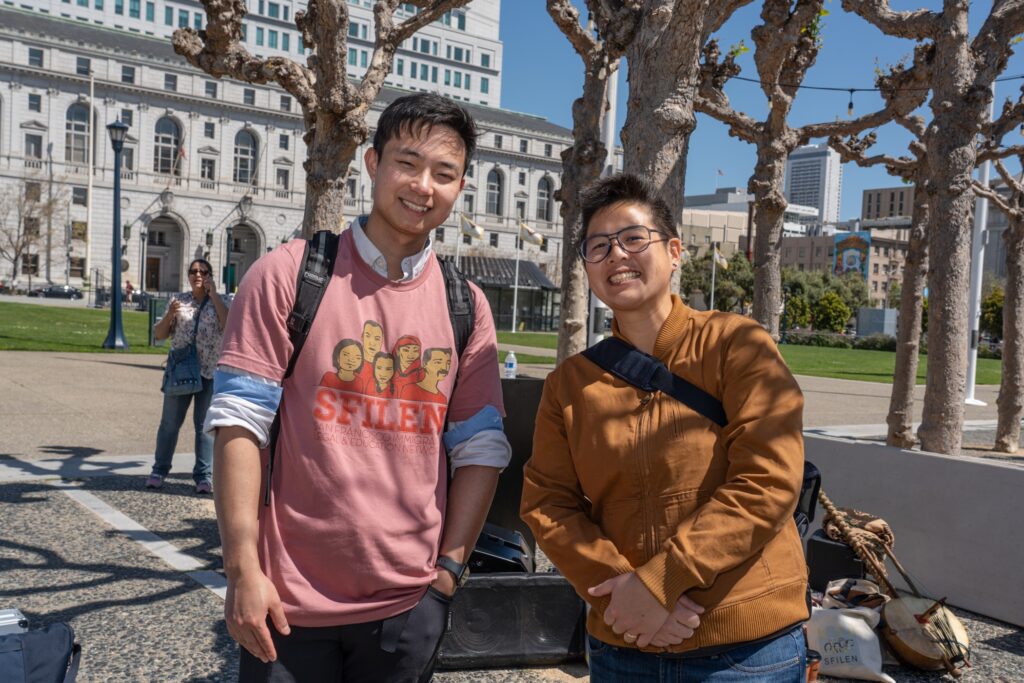
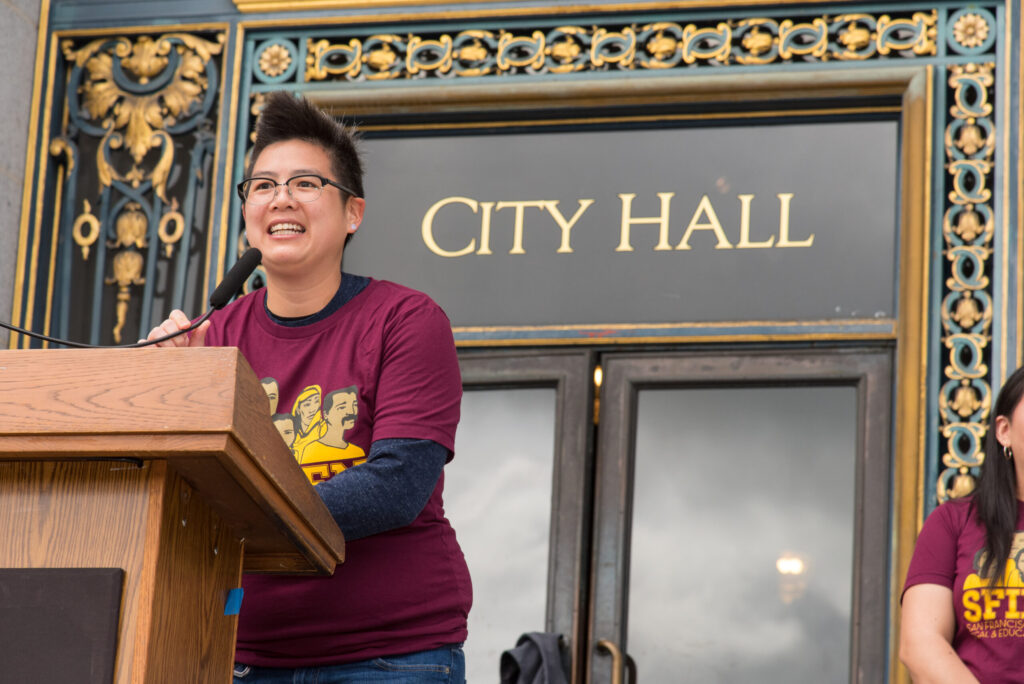
Annette Wong’s story starts in Chinatown where her parents, new immigrants in San Francisco, met for the first time, taking the bus from Chinatown to Ocean Campus to attend community college classes. From the garment industry to healthcare, to an Italian butcher shop on Grant Ave., Annette’s family has been embedded in Chinatown’s history for generations.
Today, Annette continues that story by working at CAA. As the Managing Director of Programs, Annette oversees CAA’s grassroots work in San Francisco, from direct services to community education and civic engagement.
Annette has worked at CAA for eleven years, in that time, she’s helped transform life for new immigrants in the City, fighting for immigrant rights and language access for non-English speaking residents, and managing direct services programs to help people thrive.
What is your connection to San Francisco Chinatown?
My parents landed in San Francisco Chinatown when they first immigrated. They met at City College. They got to know each other riding the bus from Chinatown to Ocean Campus, because Chinatown-North Beach Campus didn’t exist at that time.
They lived a very typical Chinatown life. My mom worked at NEMS as a bookkeeper. My dad worked at a butcher shop on Grant called the Italian Market. It’s now a souvenir shop. My grandma worked in the garment industry. My brother and I were both born at SF General, although soon after I was born, we moved out to the Peninsula. But my maternal great-grandmother and my dad’s mom — they lived in Chinatown still. So we would go to Chinatown on weekends and for special occasions. A lot of our family life was lived between Chinatown and the peninsula. Chinatown was where my family really got their start in the United States, so it definitely was meaningful for me to return.
How has your work changed over the years as CAA has grown?
In the early years, I was very hands-on with direct program work. I used to host the community workshops and do segments on Cantonese radio. I helped people fill out immigration and other forms. I accompanied parents to school sites to find solutions to problems their kids were facing. I supported the clinics, I passed out fliers, I did the ground work.
As the organization grew, my role evolved into one that is more focused on building systems, strengthening teams, and cultivating leadership amongst our staff. I think of my role now as ensuring that our program areas are integrated, streamlined, and impactful on the individual level — creating tangible change in people’s lives, and impactful on the societal level, that our services are an integral voice in our policy advocacy and strategic communications to push for broad, lasting systemic change in support of a more equitable and accessible society for all people.
How has the organization itself grown in the time you’ve been here?
When I first started at CAA, we were a very small but a mighty staff of 16 people. Today, we have over 50. But growth isn’t just measured in terms of staffing. We’ve also deepened our work, from direct services to policy advocacy to strategic communications. For example, in terms of our language access work, what began as a problem for non-English speaking community members — they didn’t have access to critical information in language — became an ongoing policy area and campaign for CAA. Now we have lead the Language Access Network of San Francisco with seven multi-racial and multi-cultural partners. We’re meeting with City departments to provide community-centered perspectives on language access, and we continue to play that bridge role of informing the community of their rights, and ensuring that City Departments are honoring those rights.
Another example is our immigrant rights work. When I started, I was the only person on the immigrant rights team. Now it’s a team of three (not including me), and we’re officially accredited to provide limited-scope immigration legal services. And we are reaching close to 7,000 people a year through our community education workshops and other resources.
Another big change is the immigration rapid rapid response hotline, which CAA helped start in 2016. We’re the only Chinese dispatchers on the hotline and our team takes a couple 16-hour shifts every week. And then, organizationally, CAA has been able to start and nurture coalitions and networks as big and impactful as Stop AAPI Hate and Asian Americans for Civil Rights and Equality.
How did CAA prepare for Trump’s second term?
What we’re seeing now on the ground is much worse than Trump 1.0. With Trump 2.0, there was a lot more foreshadowing with Project 2025. A lot of things that they planned to do, they made very clear. So, I think that in some ways, we were prepared because we saw the blueprint in advance. But in other ways, because of how rapid-fire the executive orders have been, because of how outrageous the tactics have been, it’s taken us more time to fight back on so many fronts, for example the illegal deployment of the National Guard.
We knew we had to pivot quickly. We launched and scaled up resources like our immigrant rights hotline, our “Know Your Rights” trainings, and our legal services partnerships to protect families under immediate threat of deportation. We trained more staff to be on the rapid response hotline and we developed new partnerships with groups we hadn’t worked with before, including through our Chinese Digital Engagement program.
Are there any traditions from your culture or family that you keep?
I grew up with my maternal grandma living with us, so we observed all the big celebrations. My grandma was of the generation that made everything from scratch. For new year’s, she would make ha peen (蝦餅), ha gow (蝦餃), nian gao (年糕), etc.
Same for Autumn Moon Festival and Winter Solstice — she would make savory tong yuen (湯圓), Toisan style. I try to keep that up. For New Year’s, I use her recipe to make nian gao. One of the things I really love is that at CAA we lead a grassroots celebration of the Winter Solstice. And one of the CAA outreach specialists is also from Toisan, so she’s hardcore about the savory tong yuen. I love that!
How has working at CAA impacted you?
On a very personal level, I feel like the organization has really supported me as an individual. When I first joined CAA, I had come out just a couple years earlier, and I didn’t find a lot of acceptance in my world around that. But I knew that coming to work at CAA was a place I didn’t have to worry about that. In some ways having that was a refuge for me in a trying time, not just in terms of the day-to-day co-worker interactions, but CAA was fighting for things that would protect people like me on a systemic level. So that is something that I will always be grateful for.