
There’s a wet market on 24th Street in the Mission District, and Ah Cai is a regular there. She used to shop in Chinatown, where she lived for over 30 years and knew like the back of her hand. Even after moving to the Richmond three years ago, Ah Cai still returned to shop in Chinatown — until she discovered that things were cheaper in the Mission. That’s when she switched to buying groceries there, even though it’s a bit of a detour for her.
“Vegetable prices have risen sharply in the last year or two,” Ah Cai said, listing the prices. A bunch of spinach costs $1, a chicken leg $1.09, and oxtail $9.99. A few months ago, the price rose to $10.99, and then to $12.99. “We eat according to the availability of vegetables. We buy whatever is cheapest.” She always cooks and never eats out.
This is Ah Cai’s way of life: no complaining, just finding solutions.
Bills for a family of three
Ah Cai is 60 years old this year. She immigrated to the United States 36 years ago, and most of her relatives live in the United States.
“I spent 16 years in the countryside and then seven years in Guangzhou,” Ah Cai said, referring to her hometown, Xinhui, as “the countryside.” She has seven sisters, and they all grew up lovingly together. Of Ah Cai’s four children, three have graduated from university, are working, and have started their own families. She now lives with her husband and their youngest son, who is still in university, in a Section 8* apartment in the Richmond, where the monthly rent is $851.
*Section 8 is a federal housing subsidy program in the United States that primarily helps low-income families, seniors, and people with disabilities afford rent. Eligible households typically pay a portion of their income as rent, with the remainder subsidized by the government.
She works part time as a home caregiver, two to three hours a day, a fixed 18 hours a week, earning $21.55 per hour, roughly $1,000 to $2,000 U.S. dollars a month. Her husband is hearing impaired and unable to work, receiving a disability allowance of $1,400 per month. Their youngest son is still in college and works part time tutoring students at the YMCA, bringing home up to $1,000 a month.
This family of three earns less than $4,000 a month, or a little over $40,000 a year.
On the expense side, rent is the biggest expense, and being eligible for the Section 8 subsidy is considered lucky. Next is food. Ah Cai is very frugal, keeping the family of three’s monthly food expenses under a few hundred dollars. She frankly shared that she was eligible for food stamps when she was unemployed for a while, but now that she has work again, she no longer uses them.
Next is medical care. Ah Cai has Medi-CAL, but she “doesn’t want to utilize it at all.” She felt that every time she sees doctors, they will always find some “new problems” with her health. “For example, I went in for a consultation as my neck hurts, but the doctor informed me that I have high blood pressure, high cholesterol, and high blood sugar.” She said she doesn’t dare to take medicine. “I completed one blood test and then they will prescribe five different medicination for me.” She indicated that she is afraid that “once I start taking the medication, it will never be tapered off.” She is also worried that if she loses her health insurance in the future, she will have to pay out of pocket for medication, so she simply doesn’t take them.
This mindset is also related to her 20 years of healthcare work. She has taken care of elderly patients for a long time and witnessed them counting and taking their medicines every day to maintain their health. Gradually, from those experiences, she developed her own views: “I don’t need to live a long life. I don’t want to live like that. I want to be free.”
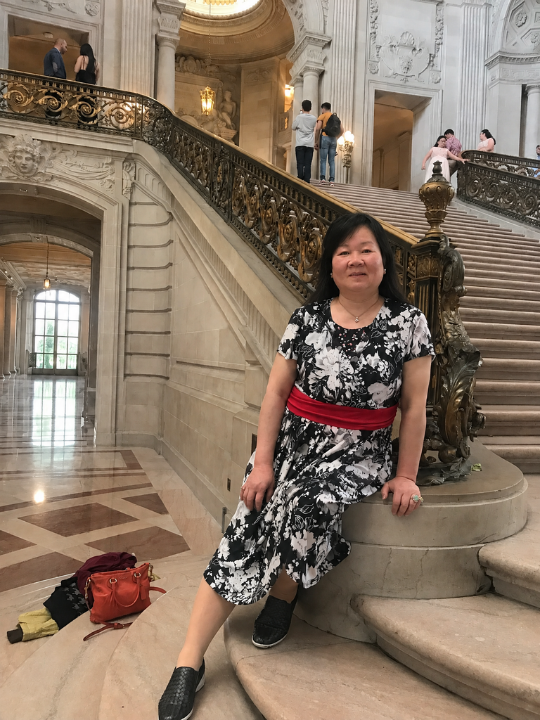
From helper to companion
Ah-Cai’s job as a caregiver was not something she had planned from the beginning.
When Ah-Cai first arrived in the United States, like many Chinese immigrants she worked as a seamstress in a garment factory, earning only $4.25 an hour. Ah-Cai was always proud of her skills. “I’ve been altering clothes for my neighbors since I was 10 years old,” she told Bay Stories. After three years, thanks to her excellent skills, her hourly wage rose to $12, but later the garment factory owner kept lowering her wages, forcing Ah-Cai to find another way to make a living.
It just so happened that she got married and had a baby around that time. Many of her elderly neighbors in the Chinatown apartment complex didn’t speak English and needed someone to accompany them to the doctor. They had no one to help them if something happened. “They gave me their phone numbers and listed me as their emergency contact,” she said. Whether it was finding a doctor, calling the police, or reading letters, everyone would come to her for help. Ah Cai jokingly described herself as a “savior” to her elderly neighbors at that time.
Later, someone introduced her to Ms. Li from Self-Help for the Elderly, and that’s how she gradually entered the healthcare industry — initially earning less than $5 an hour. She’s been doing it since 1995, with a short break where she worked as a housekeeper in the hospitality industry. However, after the pandemic, she decided to work as a home health aide again
Ah Cai says that some people may think that the elderly are “difficult to deal with,” but she feels that elderly patients actually need companionship and are easy to get along with. “When I was growing up, I was mostly taken care of by the elderly in my community, so I understand their psychology very well.” Among the elderly patients that she has taken care of, most are Chinese. As some of the patients have married caucasians, she was able to improve her English while working with them. Some of her elderly patients only read and write traditional Chinese characters while she uses simplified characters. They learned to communicate with each other through written exchange. One of Ah Cai’s clients was a 73-year-old lawyer who was tall, kind, and approachable. Once, she told the lawyer that she hoped her child could one day become a lawyer like him so that they could have a stable job, wouldn’t have to work for others, and wouldn’t have to be subservient to others. However, the lawyer shared some of the difficulties of being a lawyer, which gave Ah Cai a new perspective about the profession.
Two or three years ago, Ah Cai suffered a serious work injury. An elderly person she was caring for accidentally fell down the stairs. She instinctively rushed to help, and the two of them fell down 16 steps together. In the heat of the moment, she desperately shielded the patient in her arms, severely injuring her back and shoulder. The client passed away shortly after the accident. The accident traumatized her and she still can’t shake the incident.
Because she cares deeply about this work, Ah Cai often poured her emotions into it. Whenever an elderly person she cared for died, she would be very sad and need time to recover. This is why she took a break from the job for a period of time.
It was while caring for elderly clients that Ah Cai learned to improve her cooking skills. A client would want a particular Chinese dish one day and another dish the next, so she’d learn to make it little by little. “I’m now a very good cook,” Ah Cai said proudly. Now, in her spare time, she volunteers at the YMCA to cook. She also helps the elderly alter their clothes.
Compared to working in a crowded and complicated environment, Ah Cai prefers this relatively independent way of working. “I think I am well suited to be a home health care aide for the elderly.” When she worked in a hotel as a housekeeper, she couldn’t stand the gossip between her colleagues, so she eventually decided to return to the home healthcare industry for her peace of mind.

Raising children “on the right path”
Ah Cai’s patience and wisdom are not only evident in her caring for the elderly, but in the way she raised her children. She raised four children herself and also helped other families take care of their kids. At one point, she was looking after nine children simultaneously in her home. She would take the children to Fisherman’s Wharf, then jokingly “negotiate”: “If you’re good, I’ll give you three scoops of ice cream; if you’re naughty, only two.” Then she’d buy a large tub of ice cream from Safeway, enough for everyone. At home, she’d knead a large lump of dough and have the children make dumplings and wontons together. The children had something to do, and they could eat what they made, which gave them a great sense of accomplishment.
Ah-Cai was very strict with her children. From a young age, all four children had to speak Chinese at home and they would be fined a dollar if they spoke English at home, taken out of their $40 monthly allowance. The siblings would also supervise each other, so everyone was able to communicate in their native language at home. She also forbade the children from swearing and taught them to be kind, upright citizens and to “walk the right path.”
From a young age, her children did volunteer work, tutored during summer vacations, and participated in community activities. She believes that children should not only study, but also know how to help others.
All the children went on to do very well in school and found their own paths. Ah Cai said with a smile that her children were all part of a “rescue team.” One of them became a youth social worker, another a paramedic, and one a pilot. She said that she taught them to be kind from a young age, and the children would tell her, “When we go out into the world to work, we have to live up to Mom’s expectations.”
As she has a lot of experience in taking care of children, she was quite interested in becoming a childcare worker. However, most positions have prerequisites and require education certification, so she didn’t pursue it further. “I’m too old to study anymore,” Ah Cai said with a laugh.
“Cook and eat well every day”
It’s been 36 years since Ah Cai traveled from Guangdong to San Francisco. She has worked as a garment worker, babysat her neighbor’s children, and brought up four children to adulthood. In her later years, she is still taking care of the community by working as a home health aide for the elderly in the twilight of their lives. Every meal to her is a math problem, and every day she has to figure out how to get by.
When asked about her future plans, Ah-Cai said she intends to retire at 62. Beyond that, she doesn’t have many plans. “I’ve raised my children, helped them become independent, and put them on the right path. I’m already very content,” she said, feeling her mission is complete.
Because she’s constantly busy taking care of her children and working, she hasn’t traveled much. She’s only been to San Jose, which isn’t far from San Francisco, twice, and both times were to help friends move. She rarely goes out and doesn’t like to gossip or hang out in groups. She spends most of her time with her family or elderly relatives. In her spare time, besides volunteering, she also makes clothes. “Each piece is unique. I don’t chase after designer brands.”
Despite not being well-off, Ah Cai remains optimistic, saying, “There’s nothing to worry about, just make sure I eat well every day.”

This is an article in our Affordability Series, which documents the real-life experiences of ordinary people in the Bay Area’s Chinese community WeChat channel as they make ends meet amid the ongoing rise in the cost of living.