*At the interviewee’s request, this article uses the pseudonym “Thomas Xiao.”
In 2022, when the California Occupational Safety and Health Administration (Cal/OHSA) came under media scrutiny due to a shortage of multilingual inspectors, Thomas Xiao was interviewed by KQED through a referral and interpretation service provided by the Chinese Progressive Association (CPA).
At the time, the article focused on a long-standing issue: in California, a state with a large multilingual workforce, the number of inspectors capable of conducting workplace safety investigations in multiple languages was extremely limited. Out of 214 inspectors, only 21 held second-language certifications, 19 of whom spoke Spanish, while there was only one inspector each who was fluent in Cantonese and Vietnamese.
Thomas was interviewed as a Chinese worker who needed to communicate with inspectors in Cantonese or Mandarin. He recounted that over the course of his 30-year career, he had witnessed colleagues being injured on the job. He himself suffered a torn tendon in his right shoulder in 2019. But it wasn’t until shortly before the 2022 interview that Thomas first considered filing a complaint with the regulatory agency responsible for ensuring workplace health and safety in California — he had previously been unaware of Cal/OHSA’s existence.
For many Chinese workers with limited English proficiency, such experiences are all too familiar. Even when faced with workplace injuries, wage disputes, or unsafe working conditions, they often don’t know which agencies can provide assistance, let alone how to seek help.
Now, at nearly 70 years old, Thomas has become a “go-to source” for his friends and neighbors. He can tell them where new senior benefit programs are available and which community organizations are offering employment counseling. We recently spoke to Thomas. During our conversation, he repeatedly emphasized one point to CAA: “There are plenty of opportunities out there; the problem is how people can access information and resources.”
I’ve lived in San Francisco for 33 years and have held all kinds of jobs.
In 1993, Thomas immigrated to the United States from Guangzhou, and it has now been 33 years. Before immigrating, he worked as a reporter for the Guangdong Provincial Bureau of Posts and Telecommunications for nearly a decade. That job required him to travel frequently “all over the province,” allowing him to see many places and engage with all sorts of people. Thomas believes that his experience as a reporter profoundly shaped his personality.
“My profession taught me to seek the truth,” he told CAA. “That’s why I’m always willing to take the initiative in everything — to ask questions, to learn, and to investigate.”
After arriving in the United States, Thomas had to start over. Like many first-generation Chinese immigrants, he held a wide variety of jobs: in restaurants, garment factories, investment firms, and the cleaning industry. He went wherever job opportunities arose. At first, due to his limited English proficiency, he could only work for Chinese-owned companies. Gradually, as his English improved, he was able to take on positions that required English. Even after retiring, he continued to study English.
He retired early due to a work-related injury and began receiving workers’ compensation benefits at age 60, which were converted to Social Security retirement benefits (SSA) after he turned 62.
When he first arrived in the U.S., Thomas settled in San Francisco’s Chinatown before moving to West Oakland — he really enjoys the Bay Area’s climate. Compared to San Francisco, housing prices in the East Bay were relatively affordable back then, so he bought a house there and has lived there for decades. To this day, he makes monthly mortgage payments of about $1,000 to $2,000.
Currently, Thomas receives about $900 to $1,000 per month in Social Security retirement benefits. Since he holds a professional cleaning certification, he occasionally takes on short-term jobs to supplement his income. All told, his annual income ranges from about $15,000 to $20,000. His wife is also retired and occasionally earns some extra income by helping with child care. Their 29-year-old son lives with them and currently works as a photographer for Sing Tao Daily.
As many might imagine, living in the Bay Area on such an income must be quite a struggle. Yet throughout the interview, Thomas hardly complained about the cost of living or the pressures of daily life. Instead, he spoke repeatedly about community organizations, resources, and the connections between people.
“I’m actually quite optimistic,” he said.
Of course, he doesn’t deny that prices have risen sharply in recent years. Groceries are more expensive. So is dining out. Virtually every aspect of the cost of living has gone up. But unlike many people who focus on price changes, Thomas is more concerned with how to adjust his lifestyle within his current circumstances.
Take the initiative to build relationships and secure resources with an optimistic attitude
Thomas loves good food, but he rarely eats out. “Eating out is expensive, for one thing, and it’s not necessarily healthy, for another.” Over the years, he has gradually developed the habit of eating two meals a day: one in the morning and one in the afternoon. He generally doesn’t eat anything in the evening. “It’s been several years now, and my body has adjusted,” he said with a smile. “My digestion is better, and I save a little money, too.”
He rarely buys clothes and doesn’t spend much on entertainment. When grocery shopping, he makes a point of comparing prices and specifically chooses the cheapest items. Regarding recent inflation, he offers a typically Thomas-style optimistic take: “It’s true that prices have gone up a lot, but it also depends on whether you’re willing to put in the effort to find the best deals.”
In addition to saving money, community resources are also a vital part of his livelihood. As a low-income senior, Thomas qualifies for certain welfare programs. He applies for food stamps and also receives food from the food bank. “Sometimes that food can last me a whole week,” he says.
When it comes to healthcare, he believes the biggest challenge for many Chinese seniors is that they are unaware of the many supportive insurance programs available.
“Health insurance is complicated. It depends on your income, age, and health condition,” he says. But over the years, with the help of community organizations and advisors, he has gradually become familiar with how various health plans work. Since Thomas is over 65, some of the insurance programs he qualifies for not only cover basic medical services but also include dental and eye exams. Some even provide subsidy cards for purchasing nutritional foods — advisors match him with appropriate programs each year based on a review of his individual case.
A few years ago, Thomas underwent surgery and ended up paying almost nothing out of pocket. “The key is knowing how to apply,” he said.
Thomas emphasized that one advantage of San Francisco is that government agencies are required to provide multilingual translation services — thanks to the Language Access Ordinance — making it relatively easy for community members to access resources. At the same time, he noted that people need to “be smart” and proactively seize opportunities. “Sometimes when I’m walking down the street and see a community organization, I just walk in and ask.”
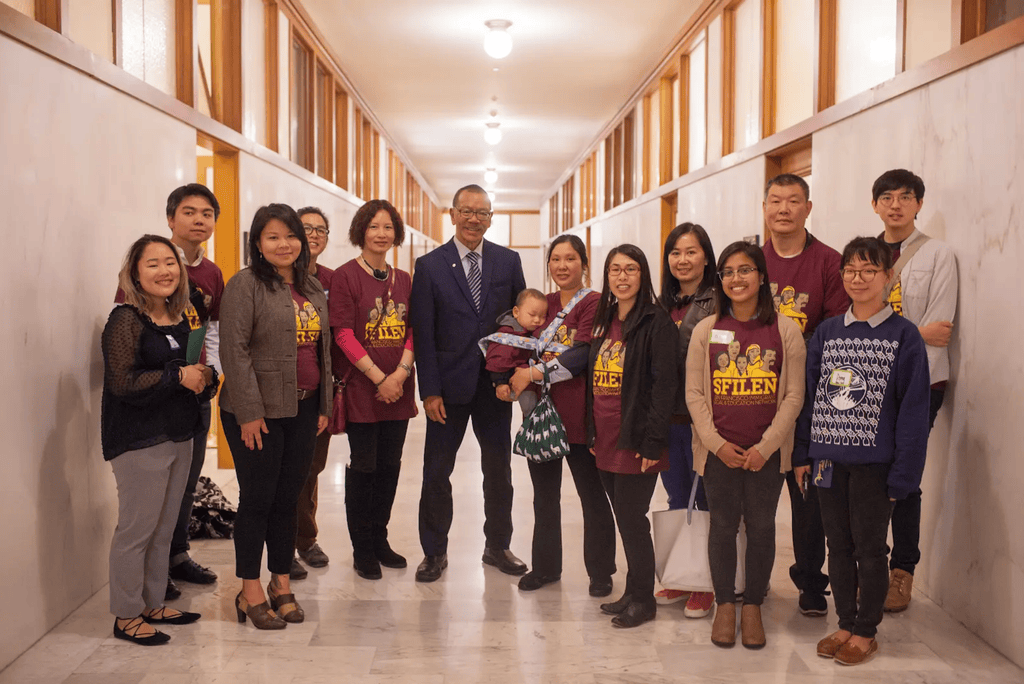
His connections with community organizations stem not only from the network he has built over many years of working in San Francisco but also from the relationships he has established. In 2018, he participated in Immigrant Family Day at San Francisco City Hall, joining CAA in making advocacy visits to elected officials. That day, he visited Norman Yee, president of the Board of Supervisors. In 2020, he joined CAA’s Census task force, distributing flyers and going door-to-door in the community to raise awareness and educate residents about the upcoming U.S. Census that year.
Thomas believes the Asian American community needs organizations like CAA to assist new immigrants who are unfamiliar with U.S. systems and resources. “Once they are aware of the resources, they can help others too.” In his view, the sharing of information and experience is itself part of the Asian American community’s strength. Many newcomers feel overwhelmed by the complex welfare, healthcare, and employment systems when they first arrive, and community organizations can help them take that first step. Once people become more familiar with their surroundings, they share what they’ve learned with friends, family, and neighbors, benefiting even more people.
In addition to participating in community organizations, Thomas also places great importance on nurturing the relationships around him. Having lived in West Oakland for many years, he makes a point of greeting his neighbors, taking walks around the neighborhood, helping people water their plants and pull weeds, or simply chatting about everyday life. In his view, these seemingly insignificant actions actually help build trust between people. “It leaves a good impression on people,” he says with a smile, “and lets them know that Chinese people are good-natured.” Over time, neighbors have come to look out for one another and share information. Whenever something happens in the community, someone will take the initiative to let him know.
At the same time, Thomas has also observed some long-standing issues within the Chinese community. He feels that many people adopt a “it’s none of my business” attitude toward public affairs and community activities. They rarely take the initiative to stay informed or build connections, only to become anxious and flustered when problems arise. “Relationships between people must be built up and nurtured over time,” he told CAA. A community doesn’t form out of thin air. It requires people to actively participate and take an interest so that they can receive support when they truly need it.
During his decades living in West Oakland, Thomas worked primarily in San Francisco, with the Bay Bridge separating the two cities. His life has largely revolved around these two cities. Since retiring, he occasionally crosses the bridge to San Francisco to participate in cultural and recreational activities such as singing and dancing. On a regular basis, he enjoys watching the Cantonese news program on Channel 26 (KTSF) and maintains the habit of reading Chinese-language newspapers. His long-standing interest in community affairs and the news has made him more familiar with San Francisco’s politics and public issues.
Thomas says one thing he appreciates about America is that everyone has a voice in influencing public affairs. Regardless of whether they agree with a particular candidate or policy, people can express their opinions, participate in discussions, and even influence outcomes through voting and community action. “It allows for different voices while also respecting the majority’s opinion,” he says.
When discussing the future, Thomas repeatedly mentions “mindset.” Having experienced immigration, career changes, workplace injuries, unemployment, and the pandemic over the years, he has gradually learned to focus on how to better accept and adapt to change. He admits that while working, he had an income but also faced work-related stress. Now that he is retired, although he has no income, he is also free from work-related stress. “The key is how you cope with societal changes to adjust your mindset,” he says.
This mindset is also reflected in his approach to raising his children. Speaking of his son, he admits that while he may not agree with every choice his son makes, he is still willing to offer support. In his view, young people must go through a process of trial and error to find the path that truly suits them. “If I oppose him, he’ll end up resenting me,” he said, adding that rather than unilaterally planning his child’s life, it’s better to let him learn and grow through his own experiences.
“If it’s something you can’t control, don’t dwell on it,” Thomas said. He pointed out that he honed his mindset over more than 30 years of life as an immigrant. He also understood that not everyone can adopt such a mindset right away. “It’s perfectly normal if others haven’t had that kind of experience yet and can’t relate to it.”
Where can I turn for help if I have a workplace injury or a workplace safety issue?
Thomas mentioned that many Chinese workers are eligible for assistance, but simply do not know where to turn for help. Below are some organizations that provide information and assistance in Chinese, as compiled by CAA:
Chinese Progressive Association (CPA)
- https://cpasf.org/workers-rights
- A San Francisco-based nonprofit community organization that offers free consultations on labor rights. Please call 415-391-6986, ext. 132, and leave a message.
Wu Yee Children’s Services
- https://wuyee.org/for-families/child-care-resource-and-referral/
- A San Francisco-based nonprofit community organization with multiple family resource centers throughout the city. Staff members can assist families in finding childcare services in San Francisco and refer them to other relevant resources.
Chinese For Affirmative Action (CAA)
- https://caasf.org/
- A San Francisco-based nonprofit community organization that invites you to participate in CAA’s monthly Community Service Day to access immigration legal and employment services.
- If you’d like to learn more about labor rights, please visit the CAA office to pick up relevant materials.
Asian Health Services (AHS)
- https://asianhealthservices.org/ch/
- A nonprofit community organization based in Oakland that provides medical, social, and advocacy services to the community.
Legal Aid at Work
- https://legalaidatwork.org/zh/
- A nonprofit legal services organization that provides a variety of information related to labor rights and offers Chinese-language resources and a hotline.
California Occupational Safety and Health Administration (Cal/OSHA)
- https://www.dir.ca.gov/dosh/
- Responsible for overseeing workplace safety, investigating complaints, and addressing work-related injury issues. Provides various safety guidelines and complaint channels.
This is the fifth article in our Affordability Series, which documents the real-life experiences of ordinary people in the Bay Area’s Chinese community WeChat channel as they make ends meet amid the ongoing rise in the cost of living.