Lau v. Nichols Resource Center
The Lau v. Nichols case began when Chinese for Affirmative Action and a multiracial group of parents filed a class action lawsuit against San Francisco Unified School District over their refusal to offer educational support to students who did not speak English. Kinney Kinmon Lau, a Chinese American first grader at Jean Parker Elementary, became the lead plaintiff in the case, which challenged the district’s failure to provide appropriate instruction to more than 1,800 students.
By 1974, Lau reached the United States Supreme Court, which unanimously ruled that denying meaningful access to education for students with limited English proficiency constituted unlawful national origin discrimination under Title VI of the Civil Rights Act of 1964 – establishing federal protections for multilingual learners that have endured for more than 50 years.
To honor the legacy of this landmark victory, we’ve gathered a collection of teaching tools, legal insights, and policy resources designed for learners of all ages. Explore the critical role that Asian Americans have played in the fight for bilingual education and how this pivotal case continues to shape classrooms, communities, and civil rights today.
Language is a Superpower! Zine
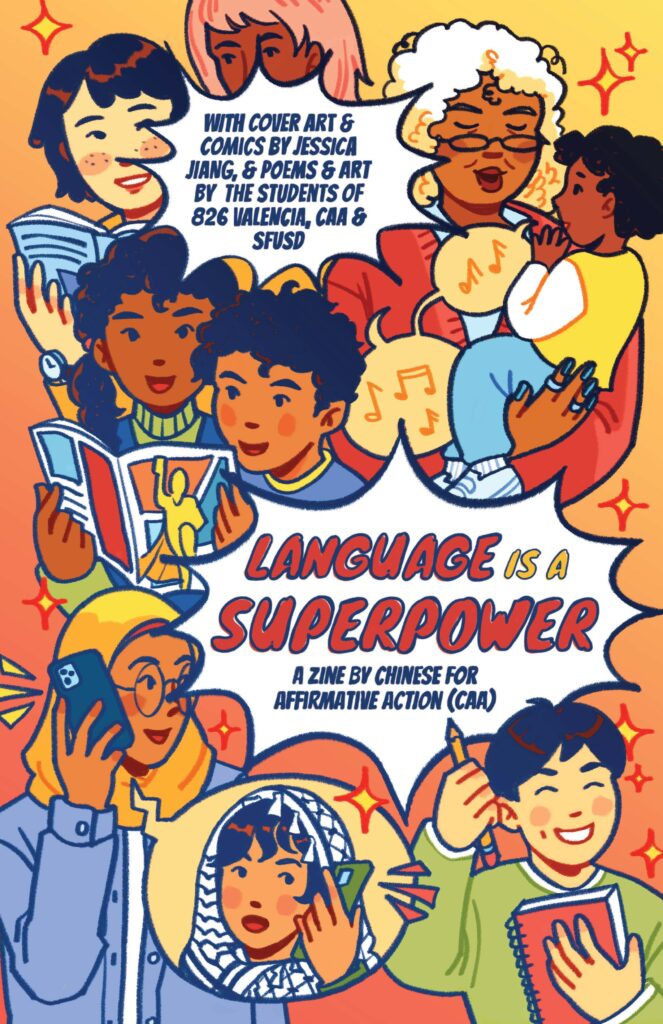
Introducing the Lau v. Nichols Zine… Language is a Superpower!
With this zine, we present to you a community-centered narrative of the story behind Lau v. Nichols in addition to the voices of multilingual learners in the San Francisco Unified School District today.
In our illustrated narrative, you will see what Chinatown was like in the 1960s, how teacher activists fought for their students’ rights, and how the fight for a bilingual education continues today. Following the illustration, the zine includes artistic works by multilingual students from San Francisco schools, representing cultures and languages in English, Chinese, Spanish, Mam, and Samoan!
Co-edited by Alice Cheng and Grace Li. Comics and cover art by Jessica Jiang.
50 Years of Lau v. Nichols
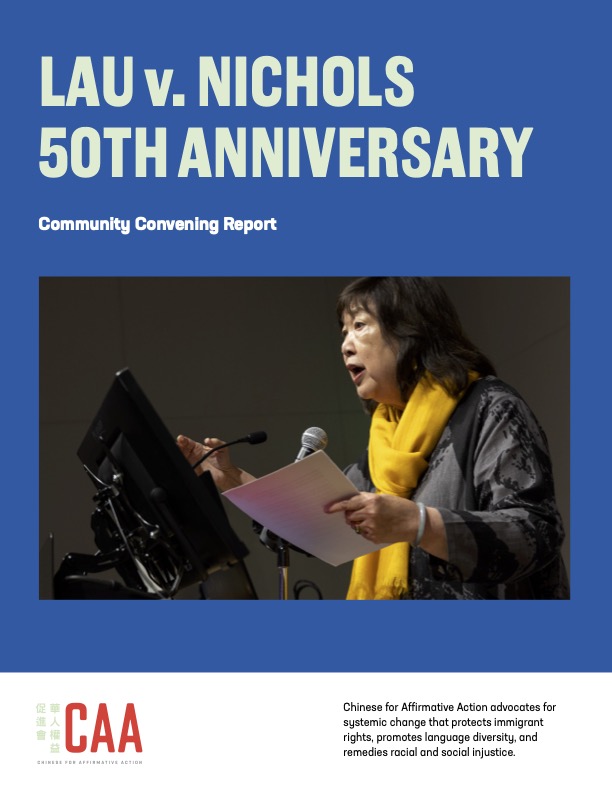
In 2024, CAA brought together students, parents, teachers, and other important stakeholders in San Francisco for a one-day community convening to commemorate the 50th Anniversary of Lau v Nichols. The event highlighted the significance of the Lau decision as a civil rights victory in education and language access, and the historic role of cross racial collaboration between progressive Black, Latino, and Asian American communities in education equity.
Lau v. Nichols Teaching Materials by Age Group
Elementary (Grades K-5)
- Lau v. Nichols Case Brief Summary
A simple and visual video explaining the main points of the Lau case. - CAA Language is a Superpower! Zine
Comic explaining the history and victory of Lau v. Nichols, including affirmative multilingual art and poems. Download a free digital copy!
Middle School (Grades 6-8)
- Lau v Nichols — How Immigrant Students Won Bilingual Education
Chinese for Affirmative Action video with primary accounts from coalition members who fought for Lau in the 1970s. - What did the Supreme Court Determine?
A digestible overview of the case and its civil rights implications, suitable for middle-grade civics or history classes. - The benefits of a bilingual brain
TedEd video explaining the learning benefits of knowing more than one language in an age-appropriate manner.
High School (Grades 9-12)
- Lau v. Nichols: The Case and Its Impact
Provides historical context and legal reasoning, useful for government or U.S. history courses. - Lau v. Nichols | Oyez
Includes audio of oral arguments and a breakdown of the decision. - California History Review – Lau v. Nichols
Lists must-know facts and review questions to deepen understanding of the Lau case and its influence on other civil rights movements. - UNIDOS: The 50th anniversary of the landmark Supreme Court Case Lau v. Nichols
Contextualizes the legacy of Lau fifty years after the Supreme Court’s decision, reflecting on its importance to all multilingual learners.
College and Beyond
- Full Case Text: Lau v. Nichols
Primary source for legal studies and policy analysis. - Stanford Archive: Federal Lau Remedies
Stanford University hosts a detailed summary of the original Lau remedies, which were developed by a federal task force to help districts implement compliant programs post-Lau. - Lau v. Nichols and Chinese American Language Rights
Offers a narrative view of the case, featuring firsthand accounts and policy analysis. Written by bilingual education historian and professor Trish Morita-Mullaney. - How Lau v. Nichols Changed Education
Includes stories from Kinney Lau’s elementary teacher, Lucinda Lee Katz, and reflections on classroom impact. Podcast episode also available. - Equal Protection for Non-English Speaking Children
A 1974 California Law Review article analyzing the case’s constitutional dimensions. - Burden Shifting and Faulty Assumption
A 2012 Howard Law Review article proposing changes to the Equal Educational Opportunities Act (EEOA) to shift the burden of ensuring equitable multilingual programs from student plaintiffs to school districts obliged to abide by the Lau ruling. - Language Rights as a Legacy of the Civil Rights Act of 1964
A 2014 UC Law article chronicling the enduring importance of Lau in protecting language rights fifty years after the supreme court ruling.
Resources for Administrators and School Districts
General Resources
- Civil Rights Principles for Multilingual Learner Education
Defines ten key principles for ensuring multilingual learners receive equitable access to education and civil rights protections. - Lau v. Nichols – The Law in Education
Offers a clear summary of the case, its legal implications, and how it shaped federal requirements for language access in schools. - Language and Education Rights of Multilingual Communities
Connects Lau to broader language rights movements and bilingual education models, including dual-language immersion. Especially useful for districts looking to build culturally responsive programs.
Supporting Early Learners
- Designing Preschool/Transitional Kindergarten (TK) Programs that Foster Bilingualism: A Guide for PreK/TK Directors
A comprehensive guide for educators on how to support dual language development in PreK and TK settings - Welcoming and Supporting Dual Language Learners
Features recommended books and classroom activities that celebrate multilingual learners. - Sobrato Early Academic Language (SEAL)
SEAL partners with schools and educators to promote research-based bilingual and dual language education programs from preschool through elementary school.
California – English Learner Roadmap
The California English Learner (EL) Roadmap builds on the foundation laid by Lau v. Nichols, translating the Supreme Court’s affirmation of language access rights into a comprehensive policy framework for equitable education across diverse classrooms.
- English Learner Roadmap
Outlines the state’s official policy framework for supporting English learners, with downloadable materials and examples. - EL Roadmap at a Glance: Information Sheet
Information sheet providing a brief overview of the EL Roadmap. - EL Roadmap Resource Hub
Offers tools, guidance, and professional learning to help districts implement California’s vision for equitable English learner education. - What is the English Learner Roadmap?
One-pager resource from EdTrust-West that breaks down the core principles of the EL Roadmap in an accessible format.
More AAPI Education and Civil Rights Resources
Legal cases
- Tape v. Hurley (1885)
A Chinese American family in San Francisco successfully challenged the exclusion of their daughter from a public school, laying early groundwork for Brown v. Board of Education. - Yick Wo v. Hopkins (1886)
The U.S. Supreme Court ruled that laws applied in a discriminatory manner violate the Fourteenth Amendment’s Equal Protection Clause, even if the law appears neutral on its face. - United States v. Wong Kim Ark (1898)
Landmark U.S. Supreme Court case that affirmed the principle of birthright citizenship under the Fourteenth Amendment of the U.S. Constitution. Read more about CAA’s work with Norman Wong, Wong Kim Ark’s great-grandson here. - Gong Lum v. Rice (1927)
Early challenge to educational inequality by a Chinese American family in Mississippi; though the U.S. Supreme Court upheld segregation here, this case foreshadowed the legal battles leading to Brown.
Political Movements
- Third World Liberation Front Strikes (1968–1969)
Student coalitions at San Francisco State University and UC Berkeley led historic strikes demanding Ethnic Studies, reshaping higher education nationwide. - Stop AAPI Hate
Stop AAPI Hate is a U.S.-based coalition dedicated to ending racism and discrimination against Asian Americans and Pacific Islanders. Stop AAPI Hate strives to advance the multiracial movement for equity and justice by building power for AAPI communities, working in solidarity with allied communities, and advocating for comprehensive solutions that tackle the root causes of race-based hate.
Education Resources and Policy
- A New Blueprint for Success: Meeting the Needs of Asian American Multilingual Students
CAA Report detailing state and local policy recommendations to improve bilingual education programs and learning outcomes for Asian American multilingual learners. - The Asian American Education Project
Offers free, standards-aligned curriculum and multimedia resources that center Asian American history, identity, and civic engagement for K–12 classrooms. - UCLA Asian American Studies Center
Rich collection of policy reports, publications, and teaching materials that highlight Asian American contributions to civil rights. - California Newcomer Network Education Law and Standards
Provides a statewide view of the legal rights of newcomer students in California, including those established by Lau. - Lessons Learned: A Resource Guide to Support AAPI Students
Post-pandemic guide for schools to support AAPI learners citing survey data from AAPI families and offering actionable policy recommendations